How many snow guards a roof needs
As snow melts it separates from the roof covering by a layer of ice about 2 cm thick and, in the right conditions, starts to move all at once. Snow guards exist to stop that movement — and if it starts anyway, to cut the snow into blocks so that only smaller, less dangerous pieces come down.
How many
Austrian and German standards call for 2 to 2.5 snow guards per square metre of the whole roof at average pitches. Locally a smaller number is used, in a layout that years of practice have shown to work.
The count depends on the roof pitch and the rafter length. Steeper, longer roofs need more rows.
- ▸Standard: 2–2.5 pieces per m² of the whole roof
- ▸The layout should reach at least halfway up the roof
- ▸Double them in the bottom row — on every second tile
Why not to skimp
Only a sufficient number, well distributed, prevents an avalanche. A few pieces above the entrance are not protection — the snow simply goes around them.
Snow coming off a roof bends and tears gutters, vents, cables and canopies, damages cars below, and can injure animals and people.
Fitting
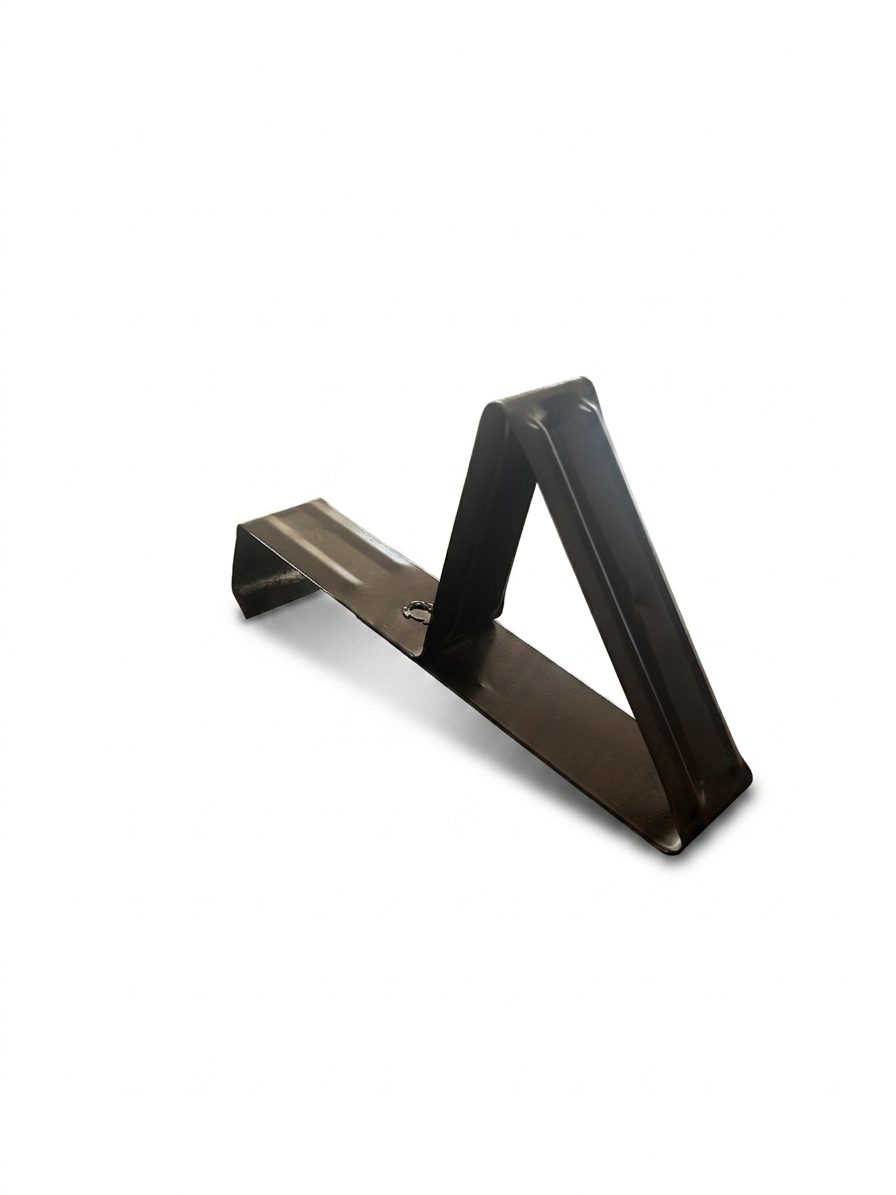
They are easiest to fit while the tiles are being laid, but they go onto an existing roof just as well: lift the upper tile slightly, slide in the hooked tip of the guard and hook it onto the tile. The hook comes in shapes matched to the particular tile.
How they are made
Snow guards are made entirely by machine, by pressing. The profile is stiffened with deep ribs, and the critical areas — the long side of the triangle and the hooked tip — are reinforced further. The triangle is joined mechanically by crimping, which gives the best joint across different materials.
They are made from 1 mm galvanised and copper sheet. Galvanised guards are then powder-coated in the matching colour.