How gutter hooks and gutters are fitted
Hooks go on first, and it is best to fix them to the roof structure, to the rafters. Everything that follows — the gutter, the outlet, the downpipe — simply follows the line they set, so a mistake here cannot be corrected later.
Fall and line
The required fall and line are best achieved with TWO taut strings. On half-round gutters one runs along the front edge of the hook and the other along the bottom, following the marker point pressed into the hook. On square gutters the strings go into the corners of the hook.
- ▸Fall: 2 mm per metre
- ▸Hooks: on every rafter
- ▸Over 10 m: two outlets, falling from the middle outwards
Laying the gutter
The gutter is laid onto the fitted hooks, pressed in so it sits on the full surface, and fixed by bending the tabs on the hooks around the front and back edges. The front tab is 1 mm thick, the rear one 0.7 mm.
Downpipe brackets
Brackets are fitted to the wall at a vertical spacing of no more than 2 m, holding the pipe 1.5–2 cm off the wall — about a finger's width. That reduces ice forming, which otherwise cracks the pipe, usually at the seam.
The bracket arm is a single piece of ø10 mm steel wire, pressed to increase its strength. Standard lengths are 150 mm, for insulation up to 5 cm, and 200 mm; longer if needed.
- ▸Bracket spacing: 2 m maximum
- ▸Pipe standoff from the wall: 1.5–2 cm
About our hooks
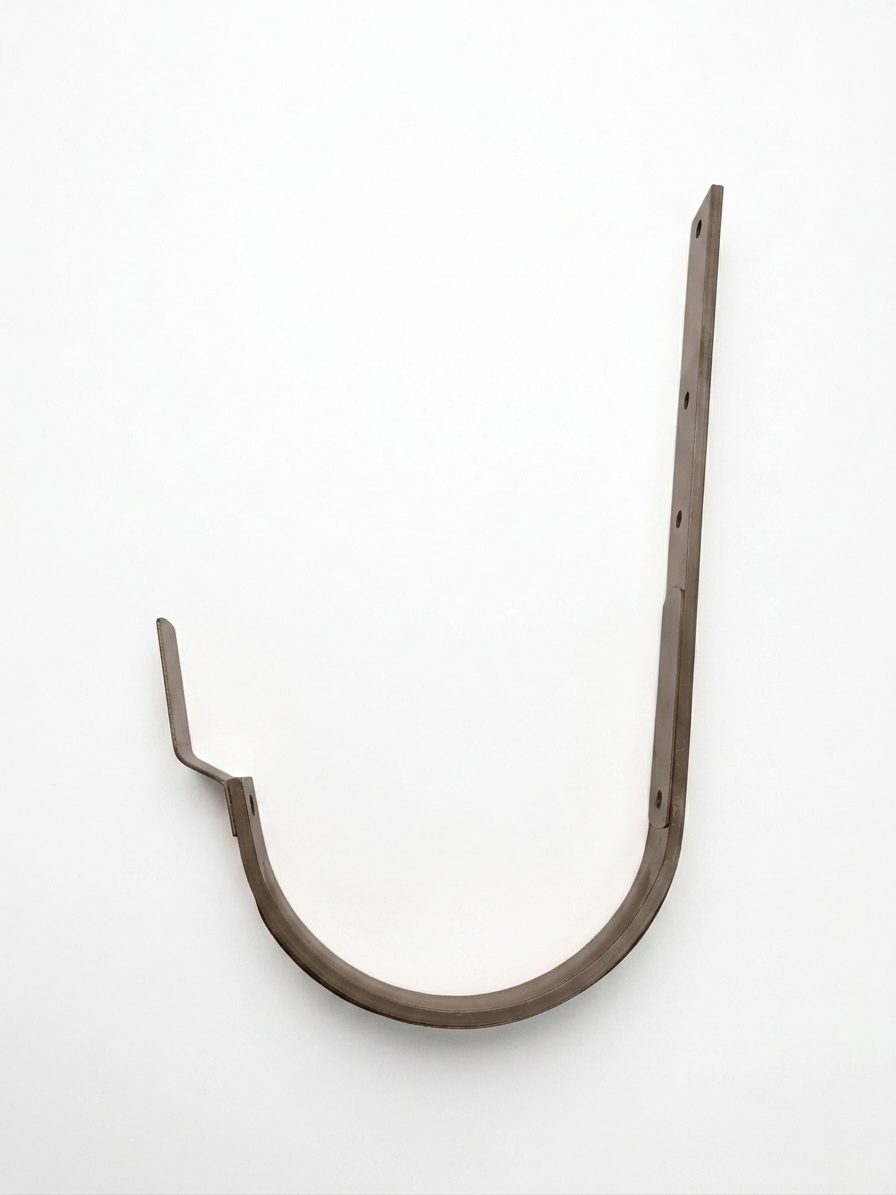
Every hook is ribbed for stiffness, and half-round hooks carry a marker point at the centre of the arc that the lower string rests on. Steel hooks are galvanised, and those supplied with coloured gutters are powder-coated for outdoor use.
All 333 hooks — round and square, steel and copper — are made with a rivetless joining system. The whole process is mechanised, which keeps quality constant.
They are made for half-round gutters of 333 mm and 280 mm developed width, and for square gutters with 110 mm and 140 mm bases. Hooks for 400 mm half-round gutters are also available.